Under-Pads or Pull-Ups: Which Line Pays Back First

Under-Pads or Adult Pull-Ups? The CAPEX Question Every Elder-Care Investor Gets Backwards
The silver economy is the largest hygiene machinery growth story of the decade. Every investor entering it asks the same first question: under-pad line or adult pull-up line? Most get the answer wrong because they benchmark against the biggest market, not against the demand they already control. This article runs the math on both.
The disposable adult incontinence market will cross USD 28 billion by 2030. Two product categories absorb almost all of it: disposable under-pads (bed pads, underpads, draw sheets) for institutional bedding protection, and adult pull-up briefs for personal mobility protection. Both are growing. Both require a hygiene machinery investment. They are not interchangeable, and the first one you build sets the financial trajectory for everything that follows.
1 · The Poland PE group that almost bought the wrong line
A private equity group backing three nursing home chains in southern Poland asked me last quarter which line to build first. Their portfolio covered 1,200 beds across three facilities. They had a site, a building permit, and a budget ceiling of USD 1.5 million.
Their instinct was adult pull-ups. Higher retail price point, stronger brand story, bigger market headlines in the investor materials they had been reading.
The numbers said otherwise — for their situation. Their own nursing homes could absorb 40% of under-pad output on day one of production. Pull-ups needed a retail distribution channel they did not have, a brand identity they had not built, and a sales team they had not hired.
The under-pad line was not the more exciting business. It was the one that worked in year one. The pull-up line was the right second line — 26 months later, once the under-pad operation was profitable and the retail relationships were in place.
Getting that sequencing right is worth more than any individual specification on either machine.
2 · Under-pad vs pull-up: what the products actually are
Disposable under-pads (bed pads)
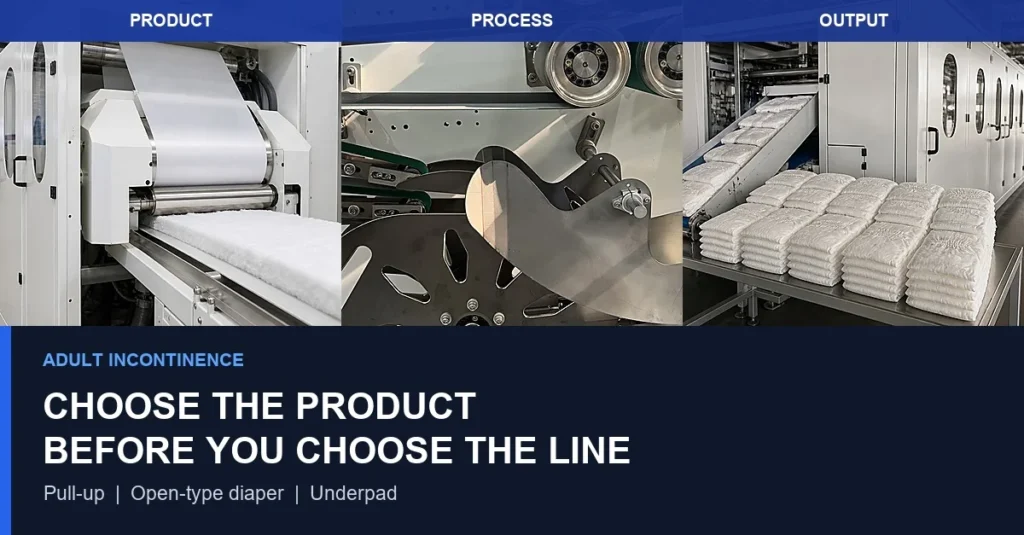
Under-pads are flat, multi-layer absorbent sheets placed beneath a patient or resident to protect bedding from incontinence episodes. Standard sizes run from 60×60cm to 90×180cm. The buyer is institutional — nursing homes, hospitals, rehabilitation centers, home care agencies — purchasing on unit cost, not on brand recognition. Regulatory classification is typically a Class I medical device or a hygiene product, depending on whether fluid impermeability is a functional claim.
Adult pull-up briefs
Pull-up briefs are worn like underwear, providing personal mobility protection for ambulatory patients. They require waistband elastics, leg cuffs, and a shaped absorbent core — a materially more complex structure than a flat under-pad. The buyer is typically retail-facing (pharmacy, supermarket, e-commerce) or institutional procurement with specific product brand requirements. Consumer perception, packaging design, and shelf presence drive purchasing decisions alongside functional performance.
3 · The CAPEX and payback comparison
The numbers below reflect actual market data from projects I have consulted on in 2024-2025, covering manufacturing operations in Poland, Turkey, Egypt, and South Africa. They are illustrative, not universal — your specific configuration, SAP loading, and market pricing will move the numbers. But the shape of the relationship is consistent:
| Metric | Under-pad line (3-layer) | Under-pad line (5-layer) | Adult pull-up line |
|---|---|---|---|
| Typical CAPEX (USD) | USD 280K – 380K | USD 380K – 480K | USD 1.1M – 1.6M |
| Output (pcs/min) | 60 – 120 | 50 – 100 | 300 – 600 |
| Gross margin (institutional) | 22 – 28% | 24 – 30% | 18 – 24% (private label) |
| Typical payback period | 14 – 20 months | 18 – 26 months | 30 – 42 months |
| Primary buyer channel | Institutional | Institutional / medical | Retail / private label |
| Sales channel required | B2B / tender | B2B / medical distributor | Retail distribution |
Read across the rows on CAPEX and payback. A 3-layer under-pad line requires roughly one-quarter the capital of an adult pull-up line, and pays back in roughly half the time. That gap does not mean pull-ups are the wrong business. It means they are the wrong first business for operators whose current demand is institutional.
4 · The 3-layer vs 5-layer decision inside under-pad
Even within under-pad, there is a tier decision worth understanding before you specify the line:
3-layer under-pad
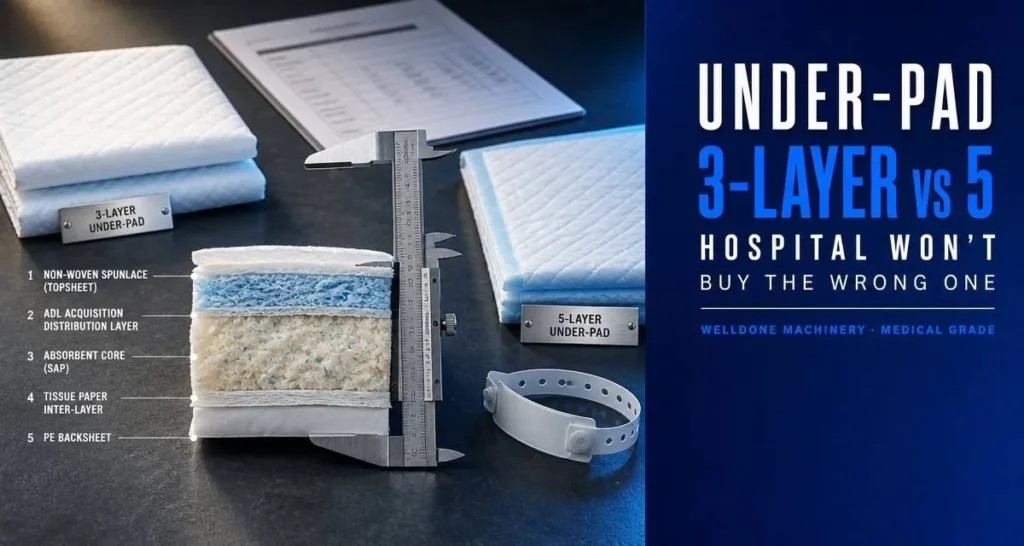
Structure: non-woven topsheet / SAP + fluff pulp absorbent core / PE backsheet. Standard for general nursing home and home care use. Adequate for most incontinence levels in non-ambulatory patients. Passes standard absorbency tests for general hygiene products. Lower CAPEX, faster payback, easier to sell to general institutional buyers.
5-layer under-pad
Structure: non-woven topsheet / acquisition distribution layer (ADL) / SAP + fluff pulp absorbent core / tissue / PE backsheet. The ADL distributes fluid faster, reducing surface rewet and skin contact time. Meets more stringent specifications required by hospital procurement, medical distributors, and EU Class I medical device registration. Higher selling price — typically 30-40% premium over 3-layer at comparable size — but requires the right buyer base to capture that premium.
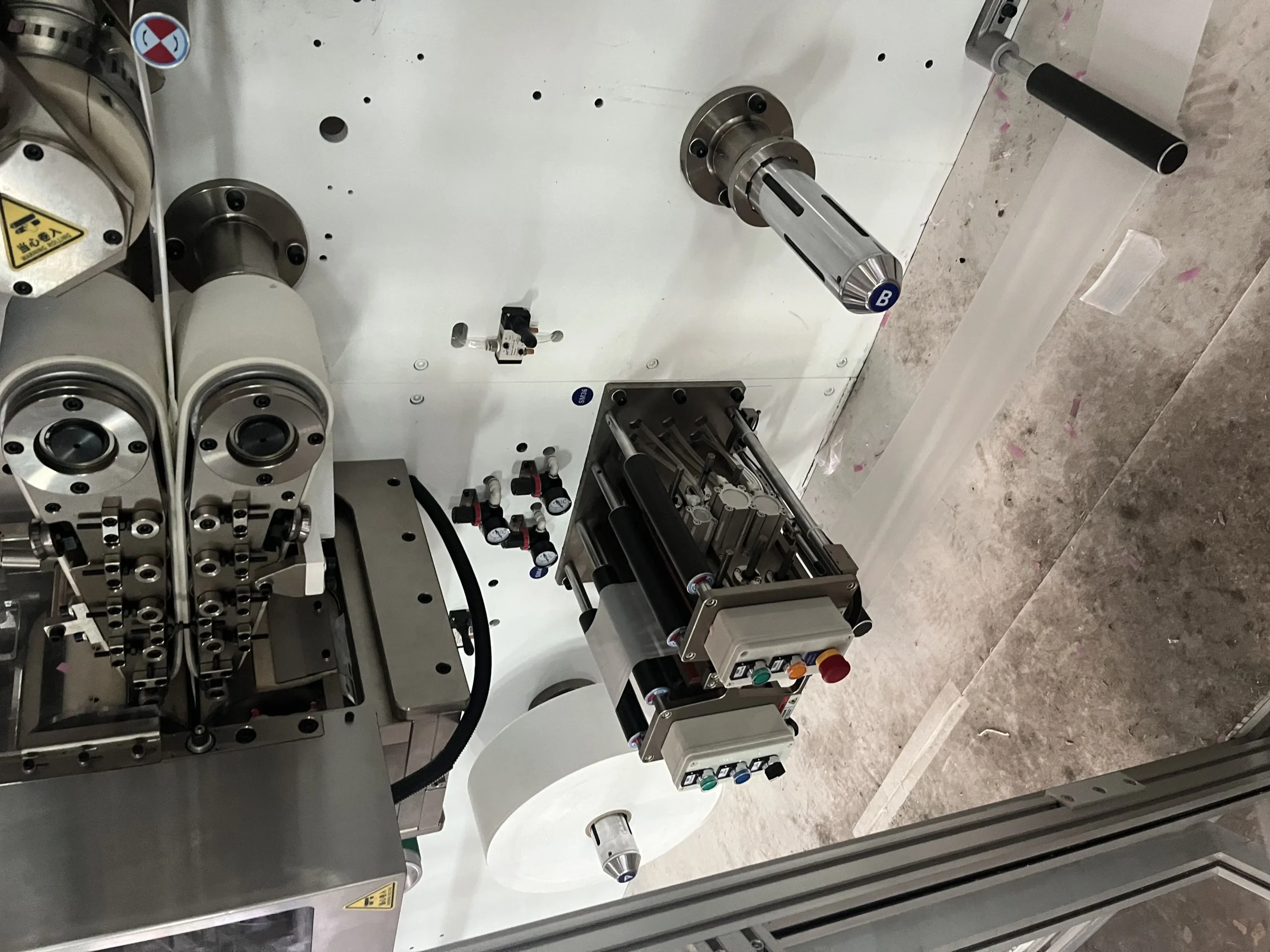
The sequencing rule for the 3-vs-5 layer decision mirrors the pull-up vs under-pad decision: match the layer count to the buyer you already have, not the buyer you plan to develop. Nursing home chains can absorb 3-layer product immediately. Hospital procurement requires a qualification process that typically takes 6-12 months — buying a 5-layer line before that qualification is complete is CAPEX waiting in inventory.
5 · When pull-ups are the right first line
Under-pads are not always the correct entry point. Pull-ups are the right first line in three situations:
- You already have retail distribution. If you own or have contracted access to pharmacy or supermarket shelf space for hygiene products, the pull-up line's longer payback is financed by immediate channel access. The brand and logistics infrastructure already exist.
- You are building for a named private-label buyer. If a retail chain has committed to a private-label pull-up program and you have the supply agreement in hand, the payback math changes fundamentally. You are not building speculative capacity; you are building committed volume.
- Your target market is a high-growth ambulatory care segment. In markets where ambulatory elder-care is expanding faster than institutional bed care — Japan, South Korea, parts of Western Europe — pull-up volumes grow faster and the payback on the higher CAPEX compresses accordingly.
In all three cases, what makes pull-ups the right answer is not the product. It is the demand structure that already exists before the machine ships.
6 · The sequencing question that decides everything
Every incontinence machinery investment decision I have seen made correctly starts with the same question — and almost every one made incorrectly skipped it:
"What can I sell on day one of production, without building a new sales channel?"
For elder-care operators with existing facilities, the answer is almost always under-pads. The facilities are the sales channel. The procurement manager is already an internal stakeholder. The volume is predictable before the first machine bolt is tightened.
For consumer goods companies entering the incontinence category from an existing retail position, the answer is almost always pull-ups. The shelf is the sales channel. The brand equity is already built. The volume is negotiable before the machine ships.
The mistake is not choosing the wrong product. The mistake is choosing before answering the question.
The CAPEX budget ceiling trap: many first-time investors set a budget ceiling and then choose the product that fits it. That reverses the decision logic. The right process is to identify what day-one demand you control, match the product to that demand, and then size the CAPEX accordingly. A USD 1.5 million ceiling does not make pull-ups the right answer if you have no retail channel — it makes a 5-layer under-pad line the right answer, with USD 1 million left for market development.
7 · Why Welldone Machinery for elder-care line investment
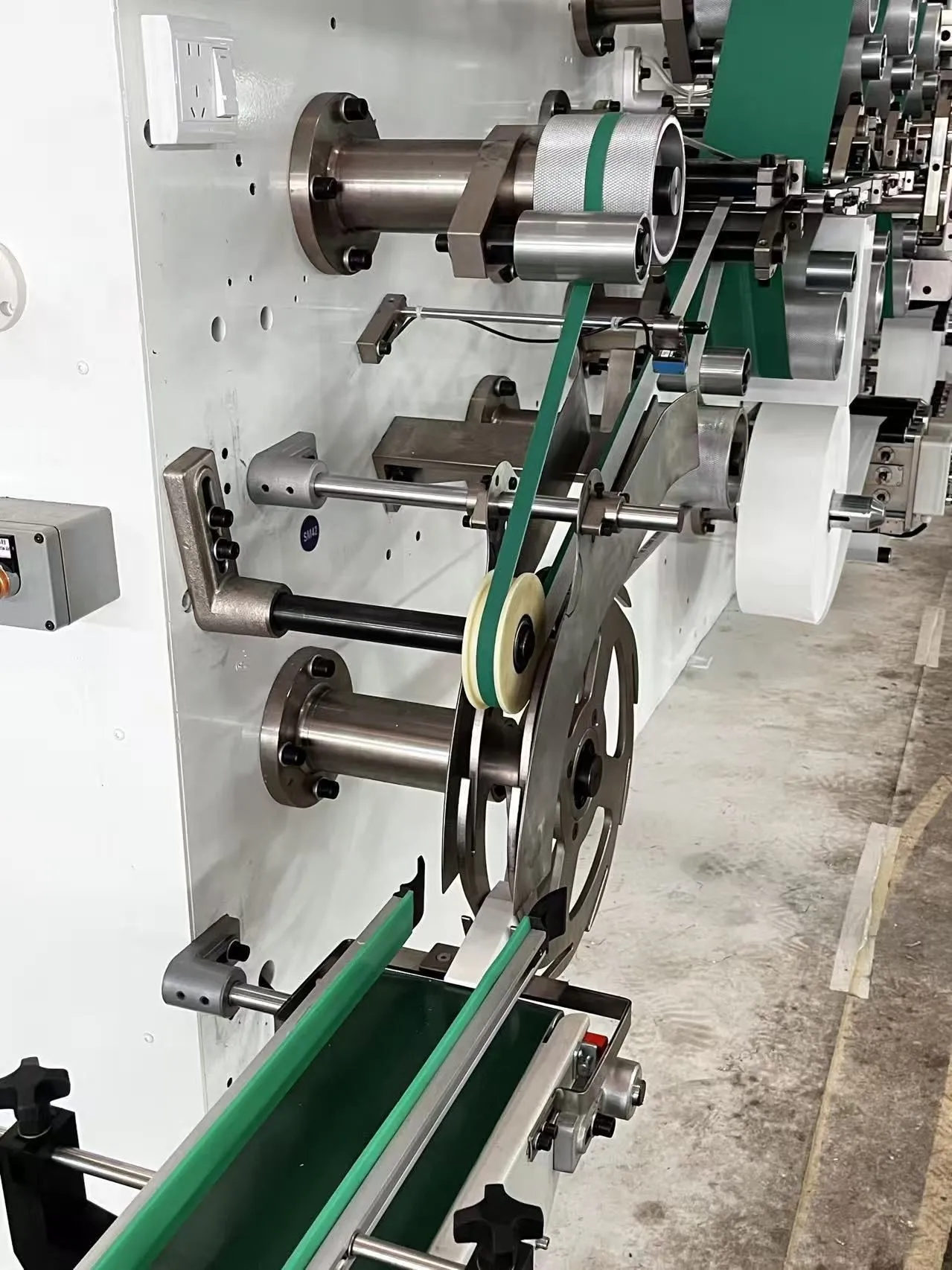
Welldone Machinery builds both under-pad lines and adult pull-up lines — and quotes both, side by side, against your specific demand profile. Every RFQ includes a payback model built on your institutional consumption data or your retail channel commitment, not on a generic market size assumption.
01 · DUAL PORTFOLIO
Under-pad and pull-up under one roof
Both product lines engineered and built in-house, with reference sites across institutional and retail channels in Europe, the Middle East, and Africa — matched to your specific market entry profile.
02 · PAYBACK MODEL
Day-one demand drives the quote
We build the payback model on your actual institutional consumption or signed retail volume — not on market headline numbers. The CAPEX recommendation follows the demand data, not the other way around.
03 · LAYER CONFIGURATION
3-layer or 5-layer matched to buyer
Under-pad layer count is specified against your actual buyer base — general nursing home, hospital procurement, or medical distributor — so the line you buy is the line your current buyers will accept.
9 · Conclusion
The adult incontinence machinery decision is not a product question. It is a demand question. Under-pads pay back faster because institutional buyers are already in the building — sometimes literally. Pull-ups have stronger long-term economics but require a retail channel and brand infrastructure that most first-time investors do not have on day one.
The investors who get this right are the ones who answer one question before they look at a single machine specification: what can I sell on day one, to buyers I already have, without building new distribution? Everything after that — product, layer count, CAPEX ceiling — follows from the answer.
An open question for any elder-care investor reading this: if you are planning an incontinence CAPEX in the next 12 months, write down the name of your day-one buyer and their committed volume before you open the first machine quotation. If that name is blank, the quotation process is premature.
10 · Frequently asked questions
What is the minimum order volume that justifies an under-pad production line?
A 3-layer under-pad line at 60 pcs/min running two shifts produces roughly 4.3 million pieces per month. For that to hit a 20-month payback at typical institutional pricing, you need annual committed volume of approximately 30-40 million pieces. For an operator managing 300-400 institutional beds, captive consumption plus one or two external institutional accounts typically reaches that threshold.
Can one line produce both 3-layer and 5-layer under-pads?
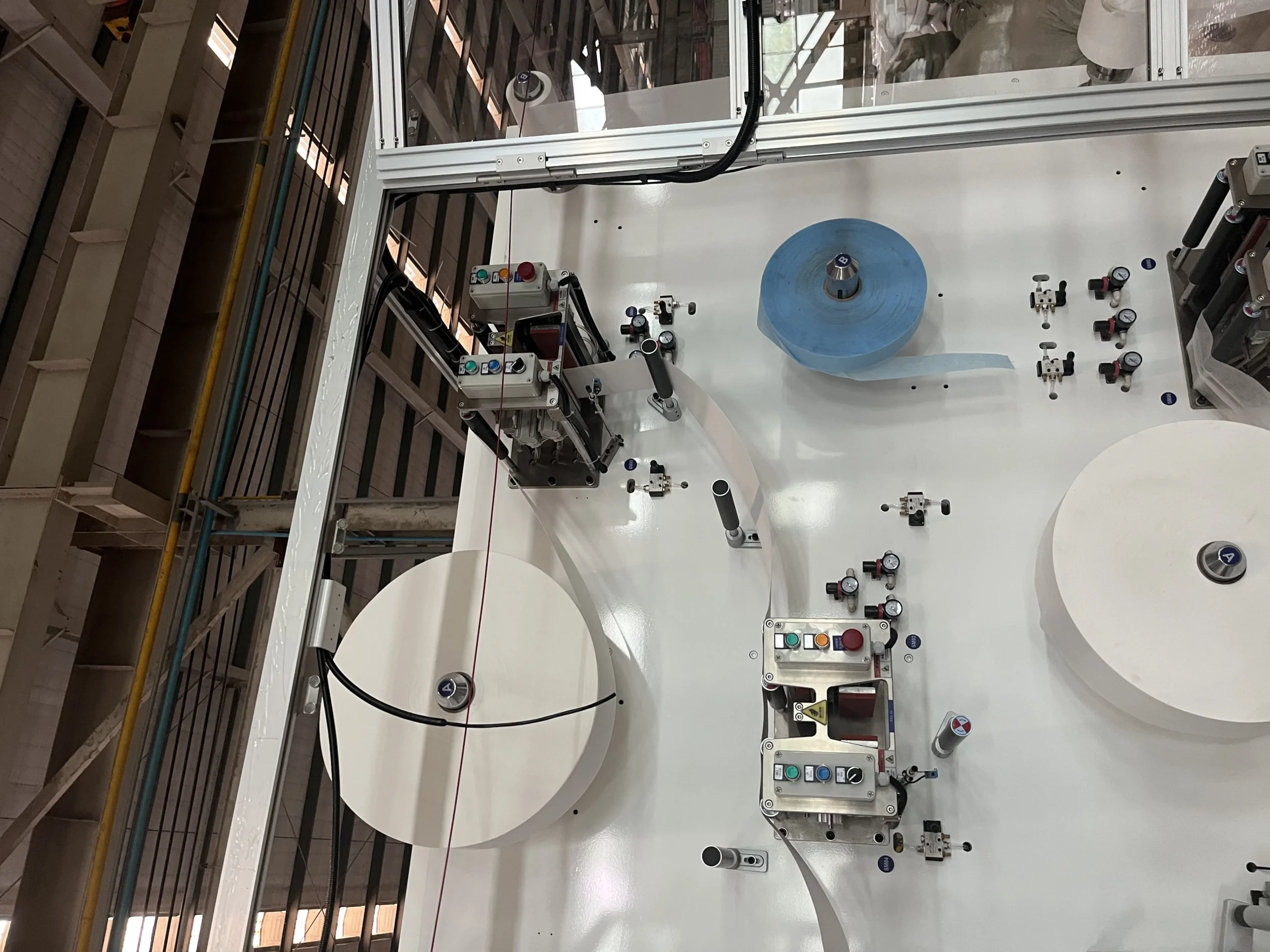
Yes, with a changeover. A line designed for 5-layer production can run 3-layer by bypassing the ADL unwinding station, typically with a 30-45 minute changeover. A line designed for 3-layer cannot run 5-layer without adding a mechanical station. If your buyer mix includes both general institutional and hospital procurement, spec the 5-layer line and run 3-layer when the ADL margin does not justify the material cost.
How long does an under-pad line take to deliver and install?
Standard 3-layer under-pad lines ship in 60-90 days from PO. 5-layer configurations with custom SAP loading and ADL integration take 90-120 days. On-site installation and SAT run 20-30 days after arrival — shorter than adult pull-up lines because the mechanical complexity is lower.
Is there a meaningful quality difference between a USD 280K and a USD 450K under-pad line?
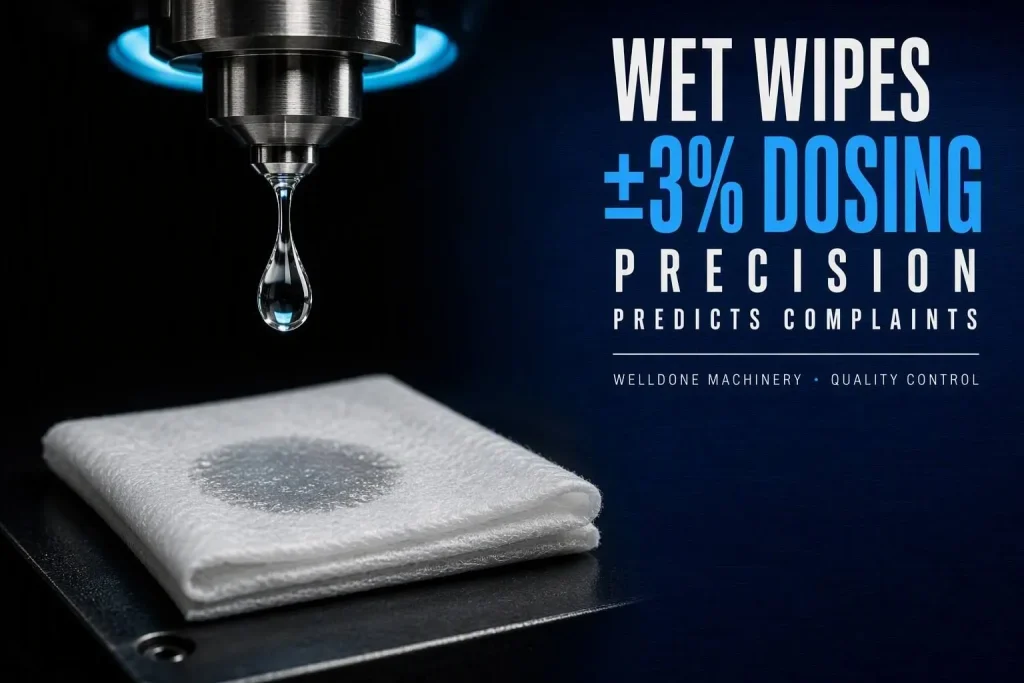
Yes, in two specific areas: SAP dosing precision and core weight consistency. Entry-tier lines hold ±6-8% SAP variation; mid-tier servo lines hold ±2-3%. For general nursing home procurement, ±8% is acceptable. For hospital procurement and EU medical device registration, ±3% is typically the specification ceiling. Buy to the specification your buyer base actually requires — and get that specification in writing from your buyer before you choose the line tier.
Can Welldone Machinery model the payback on my specific institutional consumption?
Yes. Send us your bed count, estimated daily per-resident consumption, and target selling price to your institutional buyers. We return a production-to-payback model in 48 hours — covering both a 3-layer and a 5-layer configuration — so you can make the tier decision with real numbers rather than market averages.
Planning an incontinence CAPEX — or choosing between under-pad and pull-up?
Send us your day-one buyer profile, bed count or retail channel commitment, and budget ceiling. We return a side-by-side under-pad vs pull-up payback model and a machine specification recommendation matched to your actual demand — not to the headline market size.